Page History
To promote reuse and to hide the complexity of the web service invocation, move your translate code to a self-contained reusable part.
Create a new reusable part called GoogleTranslateWebService.
Set the Target Platform to Windows/IBM iIBM i/Linux.
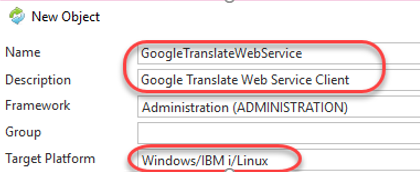
Move your code from the previous section to the reusable part.
     Begin_Com Role(*EXTENDS #PRIM_OBJT)

     Mthroutine Name(Translate)
...
Define_Map For(*RESULT) Class(#PRIM_DC.UnicodeString) Name(#TranslatedText)
...
Define_Map For(*INPUT) Class(#PRIM_DC.UnicodeString) Name(#SourceLanguage)
...
Define_Map For(*INPUT) Class(#PRIM_DC.UnicodeString) Name(#TargetLanguage)
...
Define_Map For(*INPUT) Class(#PRIM_DC.UnicodeString) Name(#SourceText)
...
Define_Map For(*OUTPUT) Class(#PRIM_BOLN) Name(#OK)
...
Define_Map For(*OUTPUT) Class(#PRIM_DC.UnicodeString) Name(#ErrorCode)
...
Define_Map For(*OUTPUT) Class(#PRIM_DC.UnicodeString) Name(#ErrorMessage)
* Insert your code from the previous section here
* . . .
* . . .
Endroutine
Other developers can now easily use your GoogleTranslateWebService component without having to understand the details of the Google Translate web service invocation.