Page History
Create a reusable part called ExternalWindowsUserServices.
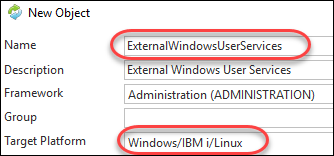
Adjust the reusable part definition to inherit ExternalWindowsServiceBase you defined earlier.

Now redefine the SetupUrlBuilder method to add the path component for the user services.
Recall the URL of the user services:
http://localhost:9001/user/
The base URL for user services' path has an additional path component 'user'. So in the SetupUrlBuilder method of the ExternalWindowsUserServices, you need to append 'user' to the URL:Mthroutine
Mthroutine Name(SetupUrlBuilder) Options(*REDEFINE)
* Invoke the ancestor's SetupUrlBuilder first
#COM_ANCESTOR.SetupUrlBuilder UrlBuilder(#UrlBuilder)
* Now this class' implementation
#UrlBuilder.AddPathComponent( 'user' )
Endroutine Endroutine
Let's now implement the Authenticate method in our RDMLX reusable part.
Mthroutine Mthroutine Name(Authenticate)
* Parameters
Define_Map For(*INPUT) Class(#PRIM_DC.UnicodeString) Name(#Domain)
Define_Map For(*INPUT) Class(#PRIM_DC.UnicodeString) Name(#UserName)
Define_Map For(*INPUT) Class(#PRIM_DC.UnicodeString) Name(#Password)
Define_Map For(*RESULT) Class(#PRIM_DC.UnicodeString) Name(#Result)
* Variables
Define_Com Class(#XPRIM_UriBuilder) Name(#Url)
Define_Com Class(#XPRIM_HttpRequest) Name(#Request)
Define_Com Class(#XPRIM_RandomAccessJsonReader) Name(#Json)
* Setup the URL's base properties
#COM_SELF.SetupUrlBuilder Urlbuilder(#Url)
* Add the 'authenticate' path component
#Url.AddPathComponent Pathcomponent('authenticate')
* Add the form parameters
#Url.AddQueryString( 'domain' 'syd' )
#Url.AddQueryString( 'username' 'tony' )
#Url.AddQueryString( 'password' 'test' )
* Execute the HTTP request
#Request.DoGet Url(#Url)
* Get the authentication result
#Json.SetSourceHttpResponse( #Request.Response )
#Result := #Json.ReadStringWithName( 'result' )
Endroutine Endroutine