Page History
配列とは異なり、コレクションでは索引によるキーは必要ありません。この例では、社員のコレクションは番号ではなく#Surnameフィールドがキーになっている点を除くと例1と同じです。
社員の名前を入力し、保存ボタンをクリックすると、社員名がコレクションに保存されます。

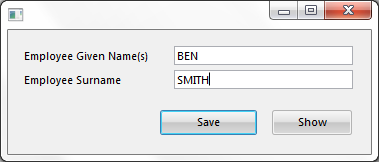
表示ボタンをクリックすると、コレクションに入力されたすべての社員がメッセージ・ボックスに表示されます。

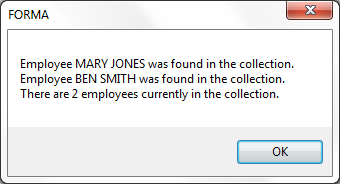
コレクションのキーは、#SurNameで一意であるため、重複する名前はコレクション内の既存のアイテムを更新します。
コレクションの定義
社員名を保存するコレクションは、以下のように定義されます。
Define_
...
Com Class(#Prim_
...
kCol<#GiveName #SurName>) Name(#Employee)
コレクションの名前は、#Employee
社員の#GiveName(名前)を収集
キーは、一意の社員の#SurName(名字)
例2:索引によるキーが必要ないコレクション
コレクションへのアイテムの追加


社員の名前全体をコレクションに保存するコードは、保存ボタンのClickイベントに置かれます。
...
Set Com(#Employee<#SurName>)
...
Value(#GiveName)
上の例では、コレクションは#Surnameフィールドでキーが付けられているので、例1のように次の使用可能なコレクション・アイテムのキーを計算する必要がありません。
例2:索引によるキーが必要ないコレクション
コレクション・アイテムの操作


コレクション内の各アイテムには、For/EndForループを使用してアクセスします。
表示ボタンのClickイベントは、各社員の#GiveNameと#Surnameの値をメッセージ・ボックスに取得するFor/EndForループを使用してコレクション内の各エントリーの参照を繰り返します。
...
For Each(#Employee_GiveName)
...
In(#Employee)
...
Key(#Employee_SurName)
...
Use Builtin(MESSAGE_BOX_ADD)
...
With_Args('Employee'
...
#EMPLOYEE_GIVENAME.
...
VALUE #EMPLOYEE_SURNAME.
...
VALUE 'was found in the collection.')
     Endfor
上の例では、以下のことに注意してください。
For/EndForループは、変数の名前(#Employee_GiveName)が参照されるたびにキーの名前(#Employee_SurName)を指定して現在のコンポーネントのキーにアクセスします。この方法で、#Surnameフィールドの値がメッセージに取得できます。
例2:索引によるキーが必要ないコレクション
コレクションの例2のソース・コード
コレクションの作成方法を見るには、このソースをコピーしてフォームに貼り付け、フォームをコンパイルして実行してください。
...
     Function Options(*DIRECT)
     Begin_Com Role(*EXTENDS #PRIM_FORM) Clientheight(124) Clientwidth(363) Height(151) Left(269) Top(185) Visualstyle(#VS_NORM) Width(371)
     * Using a Keyed Collection (PRIM_KCOL) as a keyed array.
...
     * Define the keyed collection to be used to store employee names.
     * The collection is named #Employee.
     * It collects an employee's #GiveName (given or first name).
     * It is uniquely keyed an employee's #SurName (last name or surname).
     Define_Com Class(#Prim_kCol<#GiveName #SurName>) Name(#Employee)
...
     * Define the form.
     * Field #GIVENAME allows the employee's given/first name to be input.
     * Field #SURNAME  allows the employee's last or surname to be input.
     * Button #PHBN_SAVE saves employee names into the collection.
     * Button #PHBN_SHOW shows the details of all the employees in the collection.
     Define_Com Class(#GiveName.Visual) Name(#GiveName) Displayposition(2) Height(19) Left(16) Parent(#COM_OWNER) Tabposition(1) Top(16) Width(329)
     Define_Com Class(#SurName.Visual) Name(#SurName) Displayposition(1) Height(19) Left(16) Parent(#COM_OWNER) Tabposition(2) Top(40) Width(329)
     Define_Com Class(#PRIM_PHBN) Name(#PHBN_SAVE) Buttondefault(True) Caption('Save ') Displayposition(3) Left(152) Parent(#COM_OWNER) Tabposition(3) Top(80) Width(97)
     Define_Com Class(#PRIM_PHBN) Name(#PHBN_SHOW) Caption('Show ') Displayposition(4) Left(264) Parent(#COM_OWNER) Tabposition(4) Top(80)
     * -------------------------------------------------------------------------
...
* #PHBN_SAVE.
...
Click : Save the detail on an employee in the keyed collection
     * -------------------------------------------------------------------------
     Evtroutine Handling(#PHBN_SAVE.Click)
     * Save the employee's name into the keyed collection.
...
     * The collection is uniquely keyed by #SurName so a duplicate
     * name will update the existing item in the collection. Try putting
     * in 2 employees with the same surname (eg: JONES).
     Set Com(#Employee<#SurName>) Value(#GiveName)
...
     * Clear the name fields ready for input of the next name
     * and reset the focus to the first name field
     Change Field(#GIVENAME #SURNAME) To(*NULL)
     Invoke Method(#GiveName.SetFocus)
     Endroutine
     *
...
-------------------------------------------------------------
...
* #PHBN_SHOW.
...
Click : Build a message of all the employees saved
     * -------------------------------------------------------------
     Evtroutine Handling(#PHBN_SHOW.Click)
...
     * Iterate through the collection referencing each entry in the
     * collection as an object by using a for / end for loop.
     For Each(#Employee_GiveName)
...
In(#Employee)
...
Key(#Employee_SurName)
...
Use Builtin(MESSAGE_BOX_ADD)
...
With_Args('Employee'
...
#EMPLOYEE_GIVENAME.
...
VALUE #EMPLOYEE_SURNAME.
...
VALUE 'was found in the collection.')
     Endfor
     * Show the employee count and final results
...
Use Builtin(MESSAGE_BOX_ADD)
...
With_Args('
...
There are' #EMPLOYEE.ITEMCOUNT 'employees currently in the collection.')
...
Use Builtin(MESSAGE_BOX_SHOW)
...
With_Args(
...
OK OK INFO *COMPONENT)
     Endroutine
...
End_Com
...
Example 2: Collections do not Need to Be Keyed by Index