Page History
If you
...
1. Look for an X_ERR.LOG. This will be written to the path defined by the X_RUN parameter TPTH. The default value for this path is the user's temporary folder which can be found using the shortcut %TEMP% for the path. You should refer to the Technical Reference guide for more information on how this path is evaluated. One or more of the following log files may be found:
MSIxxx.log
DPinstal.log
LANSAInstallLog.txt
LANSAInstallPermissions.txt
X_err.log
Import.log
InstallTrace.txt (requires x_run parameter ITRO=Y. This may be set globally in a Windows environment variable)
2. Turn on tracing in the LANSA Listener for the Windows server application. See the LANSA Communications Setup Guide for details on how to setup tracing. A brief description follows.
3. Turn on tracing in the LANSA application. Application level tracing is enabled by the X_RUN parameter ITRO=Y.
Turn on Tracing for the LANSA Listener.
The Communications Administration program (lcoadm32.exe) is installed to the Windows server application's \connect folder.
1a. For Windows 7, look in the Windows Start menu under your company name and application name. Double click on the Communications Administrator program.

1b. For Windows 8, use Search to find Communications Administrator, use the context menu to Run as Administrator.
2. Select Listener from the Advanced menu

a. Click the Log and Trace button.

b. Use the Select All button to show all trace options selected, as shown in the screen capture above. You should refer to the LANSA Communications Setup Guide for detailed recommendations.
c. Click OK to close the Log and Trace Information dialog.
d. Use the Stop Listener button to stop and the start the listener.

3. Run your client application to connect to the Windows Server application. Then examine the trace file which is produced. The listener trace file (lroute.trc) is written to the \connect folder in the Windows server application folder. For example:
C:\Program Files (x86)\<company name>\<application name>\Connect
Turn on Application Level Tracing
The X_RUN parameter can most easily be set by defining an environment variable or by adding the parameter to the LANSA profile file (x_lansa.pro).
1. Locate the LANSA profile file (x_lansa.pro) - for example, in the x_lansa folder:
C:\Program Files (x86)\<company name>\<application name>\x_win95\x_lansa
2. Open the x_lansa.pro file with Notepad.

3. Add an ITRO=Y parameter.
4. Optionally add a TPTH=c:\temp parameter, using any suitable folder name. The default path is the user's Windows temporary folder path (%TEMP%).
5a. Save the x_lansa.pro file, ensuring you use Save As and select Save as Type (*.*) to prevent Notepad adding txt as the file type.
5b. For Windows 8, you must start Notepad using Run as Administrator.
have already used the template on the Visual LANSA Welcome Screen to generate a mobile web application, then you do not need to complete this step. You can deploy the web application you generated earlier.
- On the Visual LANSA Home page select the Welcome Screen

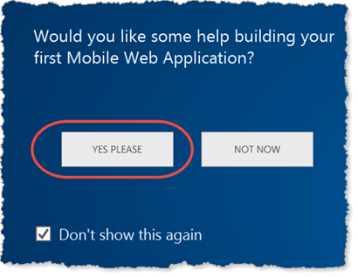
- On the Welcome Screen, click the Yes Please button
- Follow the instructions to generate a web application, using all the defaults.

- Review the About Your Application section to understand how it is structured.
- By default, the generated component names will begin "MY_". You can change this three letter prefix, if required.
- Scroll down and click Build My Application.
- The application components will be generated and compiled. A Repository List containing all components and with the name My App will be generated and shown on the Favorites tab.
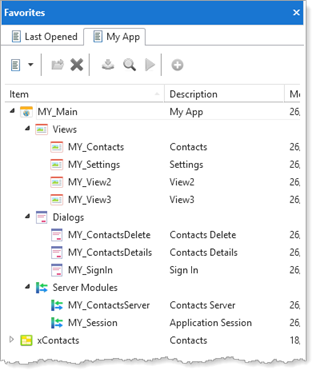
You will see an icon on the Windows Task Bar for the compile job. Nine new components will be compiled. When the compiles are finished, click the button to Execute Your Application. - The application has a View component for Contacts which accesses a shipped SQL table called xContacts (in the Visual LANSA database). Two "placeholder" Views are also included in the application.
The Contacts view lists all contacts. Click an entry, to display, edit or delete a contact.
Click the Add button at the bottom of the page to create a new contact
...
- .