Page History
A complex 5250 application that RAMP is being applied to may be visualized like this: 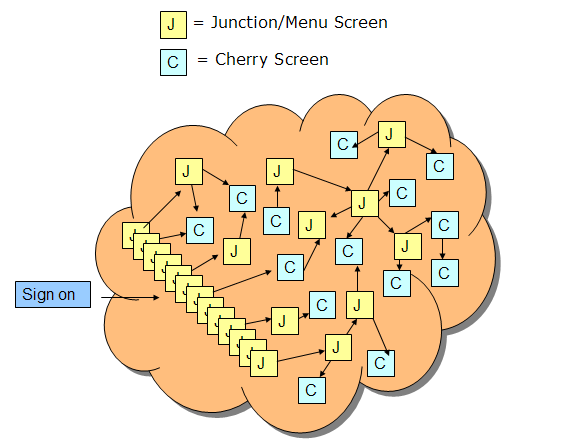
A 5250 user signs on and navigates around a cloud of menus/junctions to reach the "cherries" (5250 destination screens) where they do useful work.
...
From the RAMP developers point of view the whole process would be easier to handle if the 5250 application was actually structured like this: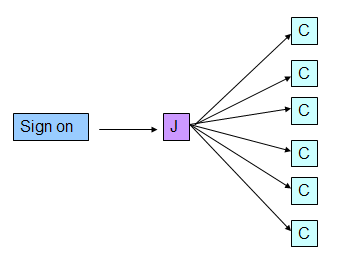
Here a single junction point (or program) controls access to every 5250 destination screen.
...
This approach is called the Single Junction Point (SJP) model.
The SJP model cannot be applied to every type of application, but where it can be applied it may represent a saving in the time taken to develop a RAMP application.
Essentially a SJP approach means that two different views of an application exist: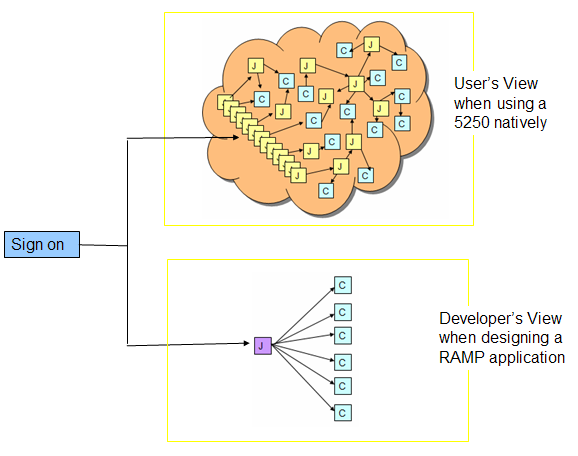
To make this programmatic view of the world the IBM i 5250 program  needs to already exist or to be created.
...
It is a program called QCMD (or Command Entry Display) and from it almost any 5250 application can be invoked in some direct or indirect way. However using QCMD is not acceptable to many sites for security reasons, so the rest of this material discusses various ways you might create your own specialized  and some of issues and additional benefits that might arise.
Is an SJP really that simple in a real application?
Can SJP do the other useful things?