Page History
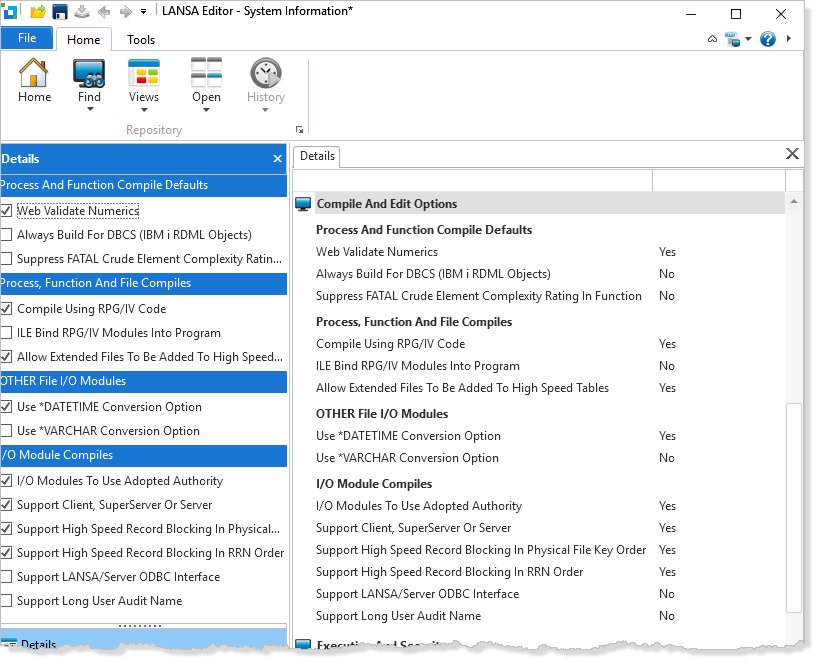
Process and function compile defaults
...
Corresponding to system flag *IOMXSERVER. See Note 2.
Use this option to indicate that I/O modules should be compiled to allow support of:
...
Corresponding to system flag *IOMBLOCKBYKEY. See Note 2.
Use this option to indicate that I/O modules should be compiled to support high speed record blocking in physical file key order. You must use this option when using LANSA/Client. You must use this option when using the LANSA/ Server *BLOCKBYRRNnnnn selection option or the "receive immediate" option. You must use *IOMXSERVER if you use this option.
...
Corresponding to system flag * IOMBLOCKBYRRN. See Note 2.
Use this option to indicate that I/O modules should be compiled to support high speed record blocking in relative record number order. You must use this option when using LANSA/Client. You must use this option when using the LANSA/ Server *BLOCKBYRRNnnnn selection option or the "receive immediate" option. You must use *IOMXSERVER if you use this option.
...
Indicates that a function that would cause the "Crude Element Complexity Rating" to return a FATAL will cause a WARNING only. It is not recommended to use this setting as the function may subsequently fail to compile.
| Anchor | ||||
|---|---|---|---|---|
|
RPGIV and ILE: Before you attempt to use any of the RPGIV and ILE related switches, it is strongly recommended that you first read ILE Implementation in the LANSA for i User Guide.
...
Also note that RPG IV (V3 version of RPG from IBM) has removed the total file, total static initialized storage and total subroutine limits that may be causing such problems to occur.
| Anchor | ||||
|---|---|---|---|---|
|
*IOMXSERVER, *IOMBLOCKBYKEY, *IOMBLOCKBYRRN and *ODBC increase the number of files declared in an I/O module, the amount of static (literal initialized) storage used by an I/O module and the number of subroutines in an I/O module. Note also that if either *IOMBLOCKBYKEY, *IOMBLOCKBYRRN or *ODBC are specified, *IOMXSERVER must also be specified.