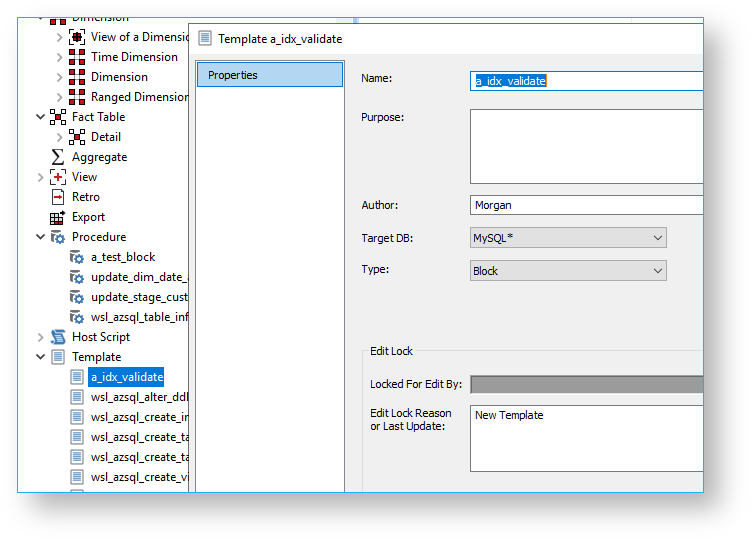
Setting up the index validate process starts by creating a template of type Block.
Following is an example of a SQL Server template:
SELECT '{{index.name}} does not exist'
EXCEPT
SELECT '{{index.name}} does not exist'
FROM sys.indexes
WHERE name = N'{{ index.name }}'
AND object_id = object_id(N'{{ index.table.schema }}.{{ index.table.name }}') |
Select the template in the Target Connection and make sure to check Enable Automatic Creation of Indexes option:

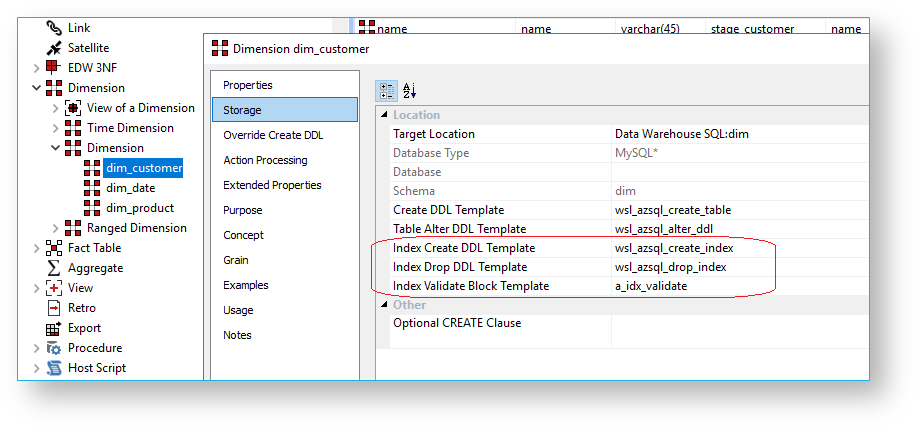
Select the index templates at the table level for existing tables, new tables pick these up automatically:
Next, an example of an index validate template for PostgreSQL:
{# -- TemplateVersion:001 MinVersion:21010 MaxVersion:* TargetType:Postgres ModelType:* TemplateType:Block       -- #}
SELECT '{{index.name | lower}} does not exist'
EXCEPT
SELECT CONCAT(i.relname,' does not exist')
FROM
  pg_catalog.pg_class t,
  pg_catalog.pg_class i,
  pg_catalog.pg_index ix
WHERE
  t.oid = ix.indrelid
  AND i.oid = ix.indexrelid
  AND t.relkind = 'r'
  AND t.relname = '{{ index.table.name | lower }}'
  AND i.relname =  '{{ index.name | lower }}'
;

{%- for col in index.columns %}
SELECT '{{ index.name | lower }} requires updating'
EXCEPT
SELECT CONCAT(i.relname,' requires updating')
FROM
    pg_class t,
    pg_class i,
    pg_index ix,
    pg_attribute a
WHERE
    t.oid = ix.indrelid
    AND i.oid = ix.indexrelid
    AND a.attrelid = t.oid
    AND a.attnum = ANY(ix.indkey)
    AND t.relkind = 'r'
    AND t.relname = '{{ index.table.name | lower }}'
    AND i.relname =  '{{ index.name | lower }}'
        AND a.attname = '{{ col.name | lower }}'
;
{% endfor %} |
|