Push notifications are a great way to keep you informed about important updates from the app. The push notifications lifecycle is the following:
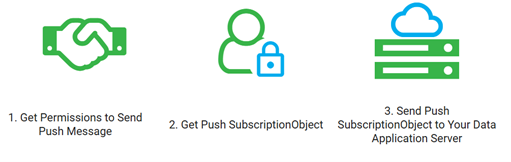
- Request Permission to send push notifications.
- A user subscribes to receive push notifications from a web application resulting in a subscription object.
- The web application passes the subscription object to the application server to store it in a database.
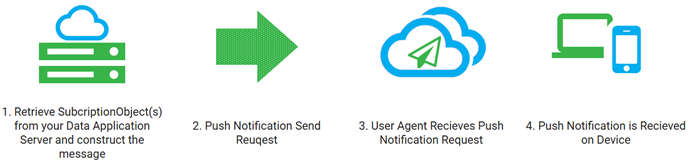
- An event is triggered on the application server to send a notification. The subscription objects are fetched from the database.
- A push notification request is sent to the user agent.
- The user agent processes the request.
- The end user receives the notification.
LANSA simplifies this entire process by making it easy to get updates:
- The Visual LANSA Web Push Manager allows the user to easily get subscribed to receive notifications and results in the subscription object.
- The subscription object is passed back to the server module and stored in a database table.
- LANSA defines an event for sending a notification. For example, the system will be undergoing maintenance at a given time and date, thereis a sale on a product or a set of tasks have been completed.
- The subscription object can then be fetched from the database table on demand to construct a custom notification for the end user
- The notification is sent from you LANSA application
LANSA’s Push Notifications implementation consolidates multiple technology stacks to allow for ease of use in your PWA application. This does away with the need for integrating multiple systems, languages and technologies, writing custom encryption programs and managing data across platforms. All that is required is Visual LANSA PWA enabled web application and an EC256 private key and you are away!